The Advantages of Terracing in Agriculture


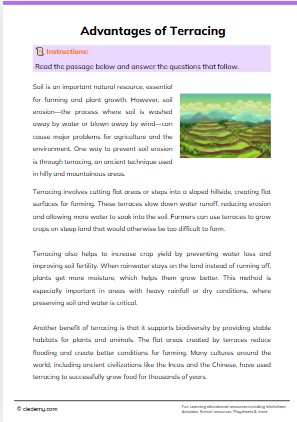
Have you ever seen farmland arranged like steps along a hillside and wondered why farmers use this design? That method is called terracing, and it has been used for centuries to make steep land easier to farm. With this worksheet, you explore how terracing helps protect soil, manage water, and support healthy crops. Each activity helps you connect geography and agriculture in ways that reveal how humans adapt to their environment. As you learn, you begin to see terracing as a smart and sustainable farming strategy.
Your journey begins with understanding how terracing prevents soil erosion. On steep slopes, rainwater can wash soil downhill quickly. Activities guide you to see how flat terraces slow down water, allowing soil to stay in place. You start recognizing how this simple design protects nutrients that crops need to grow. This builds your awareness of soil conservation.
Next, you explore how terracing improves water use. Worksheets help you understand how each terrace holds water longer, giving crops more time to absorb it. You discover why terraced fields are helpful in both rainy and dry climates. You begin seeing how farmers use terraces to control water flow and reduce waste. This strengthens your understanding of efficient farming techniques.


 G6
G6 Science
 Environment Concepts
 Agriculture
 Thinking Skills
 Educational Skills
 Scientific Temper
 Environment Literacy
 Observation Skill