

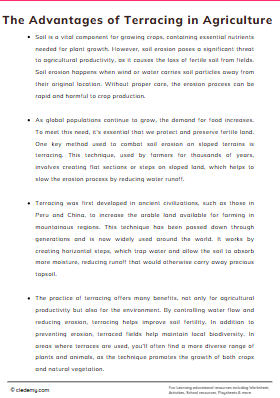
Have you ever seen farmland that looks like steps carved into a hillside? That design is called terracing, and it plays a powerful role in helping farmers take care of the land. In this playsheet, you explore how terracing changes steep slopes into flat surfaces where crops can grow safely. You discover how a simple structural change can make farming easier and more successful. Each activity helps you understand why terracing remains one of the oldest yet smartest farming practices in the world.
As you continue learning, you find out how terracing helps prevent soil erosion, which happens when rain washes away valuable soil. Without strong soil, plants cannot get the nutrients they need. Terraces act like barriers, slowing down water so it gently absorbs into the ground instead of rushing downhill. This worksheet shows you how farmers protect their land using this method. You begin to see how science and nature work together.
Terracing does more than save soil—it also helps store water. When the land is divided into steps, rainwater collects and spreads evenly across each level. This gives plants time to drink in the moisture they need. The playsheet guides you to explore how terracing supports farming in dry regions where water is precious. Understanding this benefit helps you appreciate how terracing improves crop growth and stability.










 G6
G6 G7
G7 G8
G8 English
 Environment Concepts
 Thinking Skills
 Educational Skills
 Geographical Skill
 Scientific Temper
 Analytical Thinking