Symbiotic Relationships: How Organisms Interact


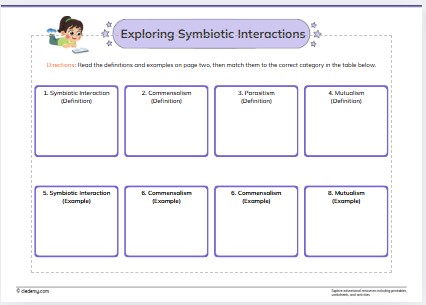
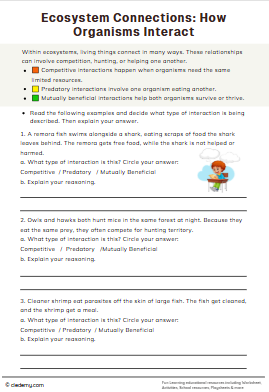
Have you ever noticed how some animals or plants seem to live in pairs or groups that benefit one another? These partnerships are called symbiotic relationships, and they are essential for survival in many ecosystems. With this worksheet, you explore how organisms interact in positive, negative, and neutral ways. Each activity helps you look closely at nature’s partnerships and understand why they matter. As you learn, you begin to appreciate how living things rely on one another in surprising ways.
Your journey begins with mutualism, a relationship where both organisms benefit. Activities guide you to explore examples like bees pollinating flowers or clownfish living in sea anemones. You’ll notice how each organism provides something the other needs—food, protection, or help with reproduction. You start recognizing that cooperation is a strong survival strategy. This builds your understanding of interconnected life.
Next, you explore commensalism, where one organism benefits while the other is neither helped nor harmed. Worksheets help you examine relationships such as barnacles attaching to whales or birds nesting in trees. You begin to see how some organisms find shelter or food simply by living near another species. This strengthens your ability to observe relationships without assuming both sides are affected.


 G6
G6 Science
 Anatomy
 Thinking Skills
 Educational Skills
 Critical Thinking
 Environment Literacy
 Scientific Temper