Are Viruses Alive


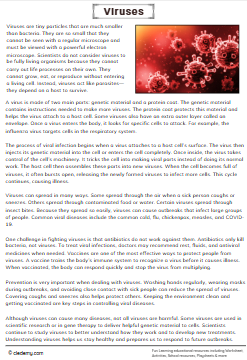
Have you ever wondered whether viruses are actually alive? They can make people sick, spread quickly, and even change over time—but they don’t behave like plants or animals. With this worksheet, you explore what it truly means to be “alive” and where viruses fit in. Each activity encourages you to think carefully about scientific definitions. As you learn, you begin to understand why this question has puzzled scientists for years.
Your journey begins by exploring the basic characteristics of living things. Living organisms grow, use energy, respond to their environment, and reproduce on their own. You’ll examine how bacteria, plants, and animals meet these requirements. Activities guide you to compare these traits with the behavior of viruses. This helps you build a clear framework for scientific thinking.
Next, you take a closer look at viruses themselves. Viruses are much smaller than cells and are made of genetic material wrapped in a protein coat. They cannot eat, grow, or reproduce by themselves. Through this worksheet, you learn that viruses must enter a living cell to make copies. This important detail helps explain why viruses seem alive in some ways but not in others.


 G6
G6 G7
G7 G8
G8 Science
 Anatomy
 Life Skills
 Thinking Skills
 Educational Skills
 Scientific Temper
 Critical Thinking
 Research Skill