
 31
31Breathing and Exchange of Gases


When you explore Biology, Chapter “Breathing and Exchange of Gases”, NCERT, you begin to understand how your body continuously supplies oxygen to cells and removes carbon dioxide. You connect breathing with cellular respiration and realise that every breath supports energy production. You observe how different organisms use gills, lungs or body surfaces for gas exchange, helping you appreciate adaptation and survival.
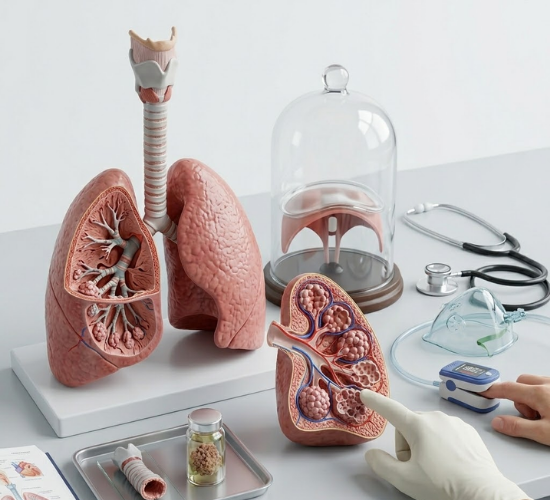
As you study the human respiratory system, you trace the path of air from nostrils to alveoli. You understand how the conducting part filters and humidifies air, while the respiratory part enables diffusion. You analyse the role of the diaphragm and intercostal muscles in creating pressure gradients during inspiration and expiration. This strengthens your understanding of how structure supports function.
When you examine respiratory volumes and capacities—tidal volume, vital capacity and total lung capacity—you build quantitative clarity. You learn how a spirometer measures lung function and why these values are clinically important. This improves your ability to interpret physiological data and apply it to health contexts.


 G11
G11 Biology
 Health
 Thinking Skills
 Analytical Thinking
 Visual Recognition Skill
 40
40 40
40 40
40 20
20 1
1 51
51 10
10 40
40 20
20 20
20